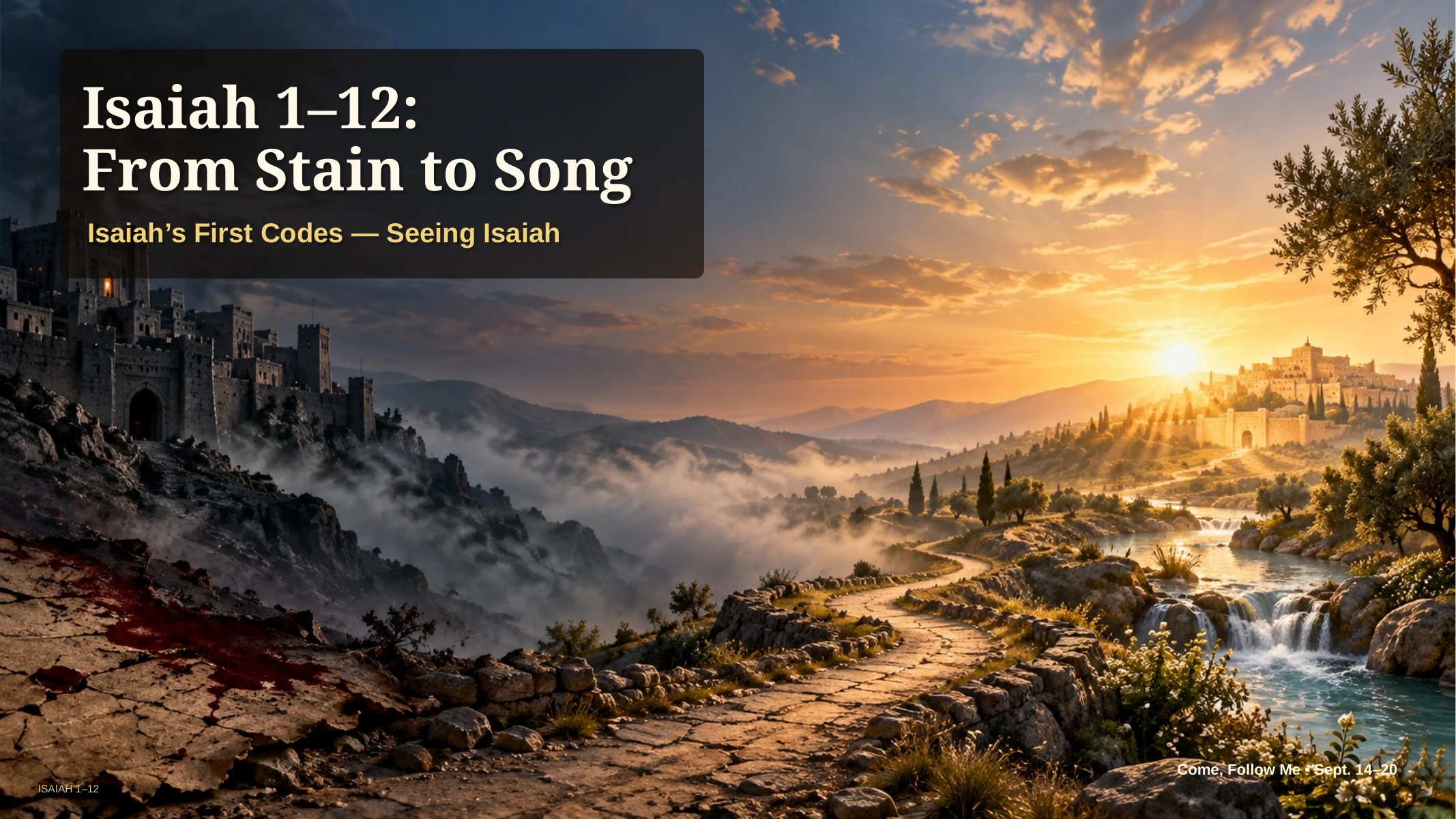
September 14–20, 2026 · Official reading: Isaiah 1–12
The Ladder Hidden Inside Isaiah
Seven levels, one gate, and a question from a fourteen-year-old that stopped the class.

A girl walked into my Sunday School class who had missed the week before. Before I said a word, the other kids taught her the code.
I had given a quiz to whoever showed up early — one question, about the first code we learned in Isaiah. They got it. Then they turned and handed it to her. One of them went further and named which figure in Isaiah stands for the adversary and which stands for the Lord’s servant, which I had not even mentioned yet. I asked if his family had been decoding some of this at home. He said yes.
One week. And the code moved from student to student without me.
That is the whole thesis of this project, demonstrated by fourteen-year-olds in under three minutes.
Quick review, because you may have missed it too
Last week Solomon handed us the key — in a book most people do not know he wrote. The thing that hath been, it is that which shall be (Ecclesiastes 1:9). Then the first code: when Isaiah says Egypt, look for the superpower a covenant people trusts instead of God.
That is interpretation, not translation, and I label it so every time. The full case is in When Isaiah Says Egypt, He Means America.
Today we add seven more codes. First, why search rather than skim?
Often quoted. Still worth searching.
This week’s Come, Follow Me manual says Isaiah is the Old Testament prophet most often quoted in other books of scripture, including by the Savior. The same lesson asks us to search his words diligently and offers ways to understand his symbols.
BYU’s Scripture Citation Index is another way to explore where Isaiah appears in general conference, the Journal of Discourses, and Joseph Smith’s teachings. The number of citations depends on the collection and how passages are counted; I would rather send you to the index than give you a total I cannot reproduce here.
Two witnesses on why it is hard
Joseph Smith said something in 1843 that ought to stop us:
“The book of Revelation is one of the plainest books God ever caused to be written.”
— April 8, 1843 (History of the Church 5:342)
The plainest book. The one nobody can read.
And Nephi says the same thing about Isaiah, with the condition attached:
“The words of Isaiah are not plain unto you, nevertheless they are plain unto all those that are filled with the spirit of prophecy.”
— 2 Nephi 25:4
Two men, two books, one claim. The difficulty is not in the text. It is in the reader — and the fix is named.
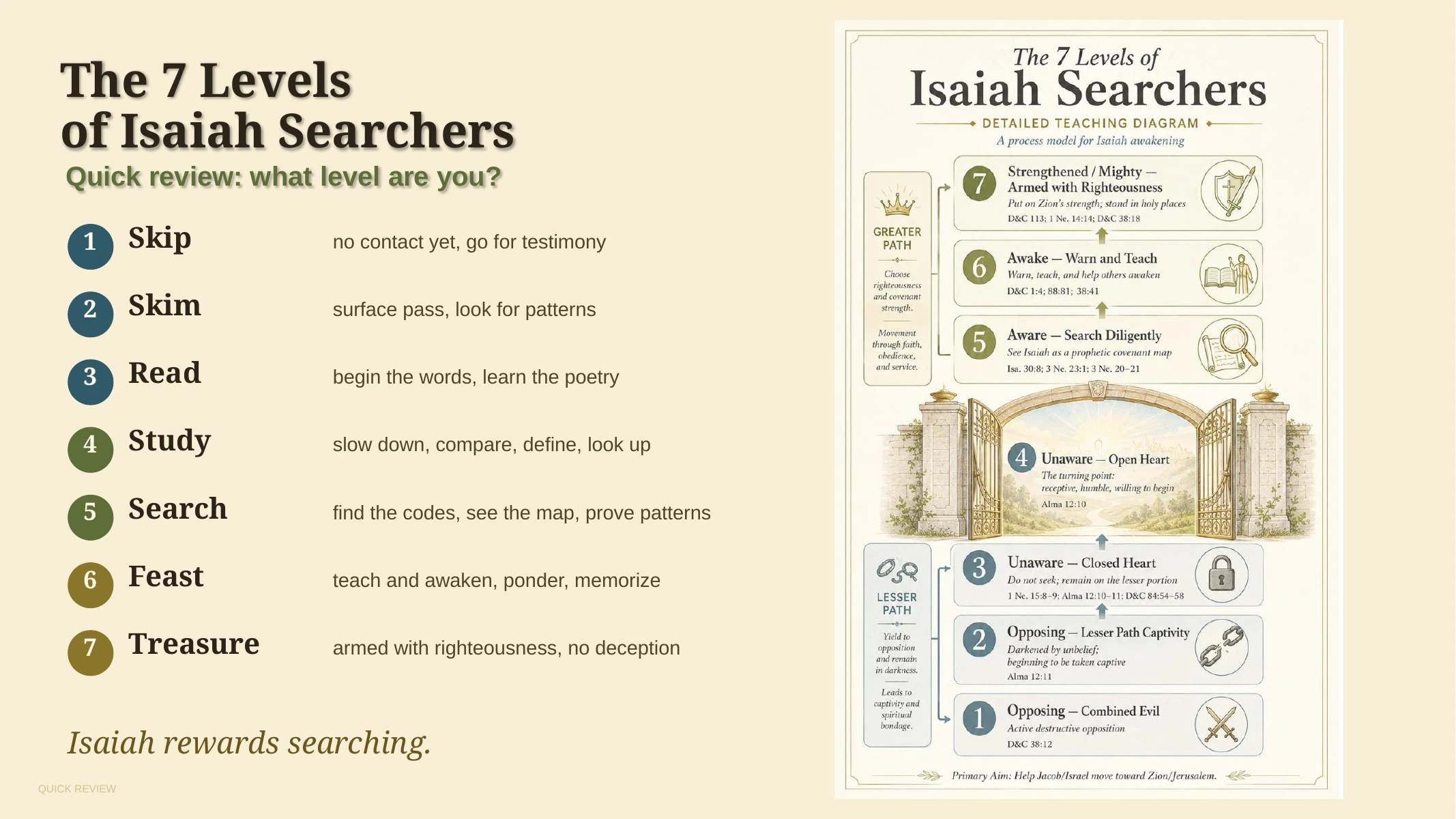
So here is the 7 levels of Study, and Searchers

This is something I built, and I actually combined two slides into one to save space in a 25 minute class, and when I put it up the class got out of their chairs to come look at it.
Level one opposes the scriptures outright. Level two opposes them because they are captive to something else — an addiction, a worry, a life they do not want disturbed. Level three has a closed heart, not from malice but because they are not aware there is anything to learn.
Level four is the gate.
Level four is a person whose heart is open. They do not understand Isaiah. They may not even believe it is encoded. But they are willing.
Here is what matters about that line: the knowledge is identical on both sides of it. Level three and level four can have read the same chapters and know the same facts. The difference is the heart. That is where I hope you are. It is where I hope I am.
Level five is aware — they know something is going on in there. Level six is awake — they have the code and they teach it. Level seven is armed, and no deception reaches them.
Find what level you are standing on. Nobody is watching.
A student asked the best question of the hour — well, of the twenty-five minutes
I explained that Isaiah’s entire purpose is to move people up a level or two. A fourteen-year-old raised her hand and said: how do you move up a level or two? That is one of the most important questions anybody can ask, and here is why.
When I teach you what to do, that is knowledge. When I teach you how to do it, that is wisdom.
The Church’s 2026 seminary study-skills lessons teach students to look for Christ, find gospel truths, annotate scripture, invite the Holy Ghost, and compare passages. Learning how to study and how to search is itself part of the curriculum.
The question is how we help a willing student practice those skills. Give a man a fish and he eats today. I am not going to hand you twelve fish this week. I am going to show you a good fishing hole, how to tie a fly, and how to cast.
And then we answered the boy’s question from scripture
I will not ask anyone to take my word for doctrine. So Marty McCain — my mission companion from forty years ago, now our ward clerk, who came in to help while my wife Crystal was home with both eyes infected — opened his scriptures and read it out loud:
“And now, because of the covenant which ye have made, ye shall be called the children of Christ, his sons, and his daughters; for behold, this day he hath spiritually begotten you; for ye say that your hearts are changed through faith on his name; therefore, ye are born of him and have become his sons and his daughters.”
— Mosiah 5:7
You move up by being born again. Not metaphorically. Adopted. You take His name by partaking of His Atonement, and He becomes your Father in a way your birth certificate never recorded.
I know something about that.
I was adopted when I was eleven days old. I did not learn who my birth family was until four or five years ago. My birth mother was named Irma Jean Groberg — and her uncle was John H. Groberg, whose mission to Tonga became the film The Other Side of Heaven.
That was my favorite movie for years before I had any idea he was my distant uncle.
My father’s name I will not tell you. It is bad enough that a biological brother I did not know I had changed his.
I got a new name when I was eleven days old, and it was mercy. That is what Mosiah 5:7 is describing when we partake of the Atonement of Christ and get adopted into His family, and I am not speaking about it theoretically.
Isaiah’s ladder is the plan of salvation
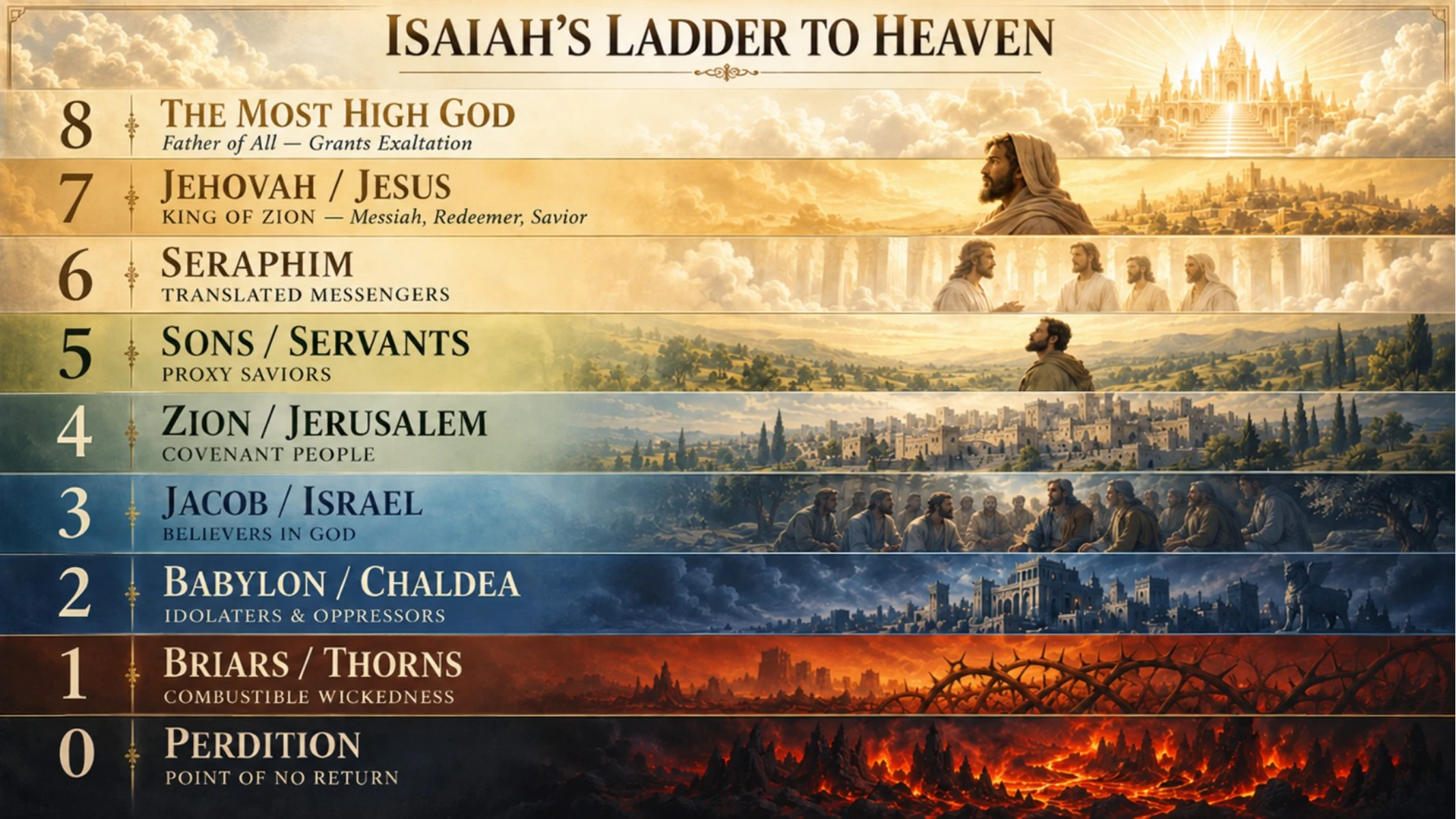
The seven levels above describe how a reader approaches scripture. The following nine-step ladder is a separate interpretive framework associated with Avraham Gileadi’s reading of Isaiah’s covenant world. Use it as a study map and test each step against the text.


Here is the part almost nobody is told: the levels are in Isaiah, and they are his code. They were worked out by a scholar we are going to talk a great deal more about in the weeks and years ahead — a man who has spent a lifetime inside this book and whose work is the reason I can teach any of this.
Watch what he does when he opens a new section. When Jacob and Israel appear together in a verse, he is addressing one group. When Zion and Jerusalem appear together, he is addressing a higher one — people who kept the covenant through trial.
Jacob and Israel are believers. Zion and Jerusalem are those who walk the covenant path and stay on it.
Below both of them: the world. Below that, briars and thorns. Above them: sons and servants, then seraphs.
The entire book is a ladder, and every warning in it is an invitation to climb one rung.
(Reading Isaiah’s spiritual categories this way is interpretation — the pattern is in the text, the naming of the levels is a reading of it.)
The chapter that should have come first

Here is something that will reorganize the whole book for you.
Isaiah 1 is not the beginning of Isaiah. Isaiah 6 is.
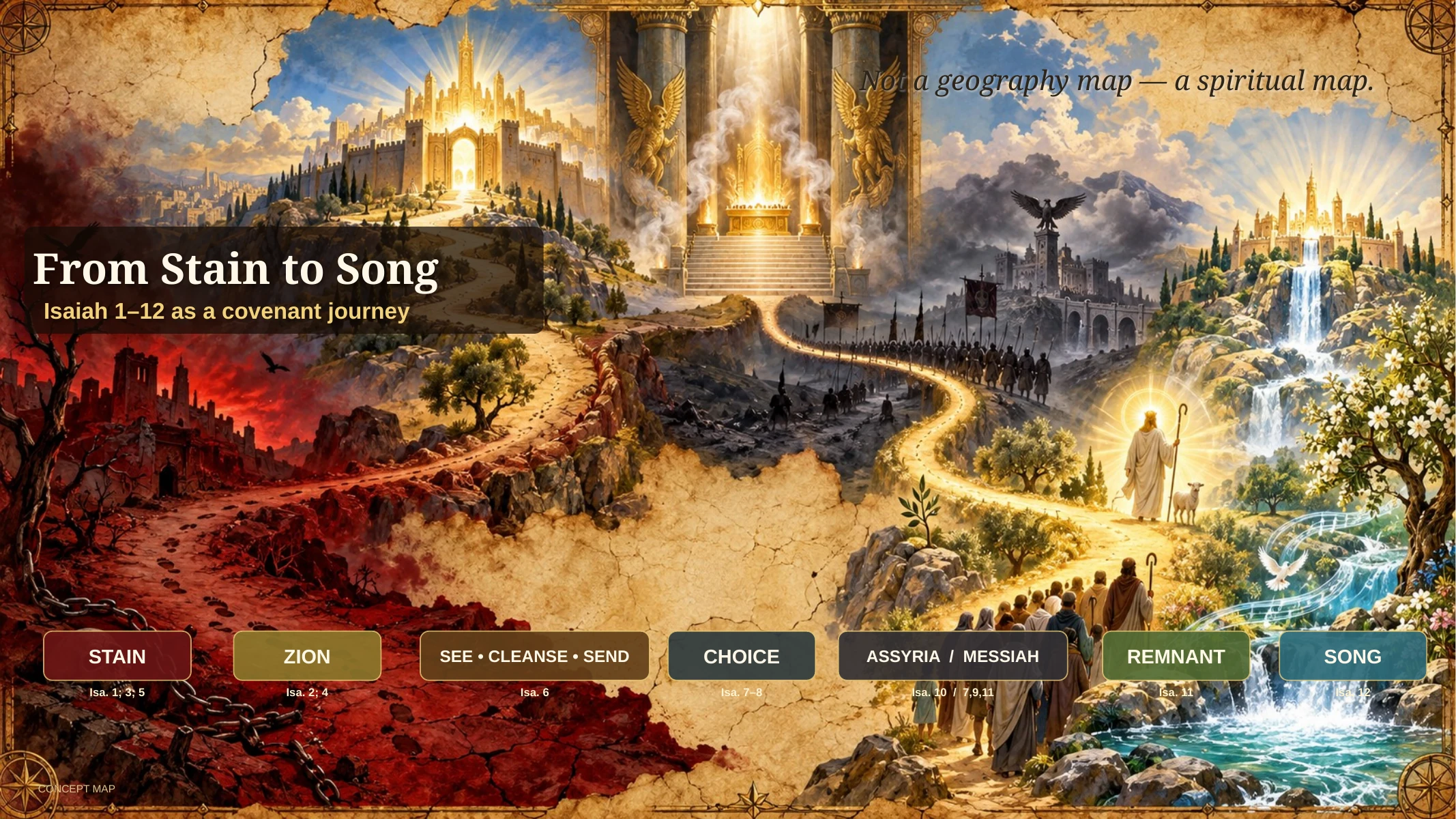
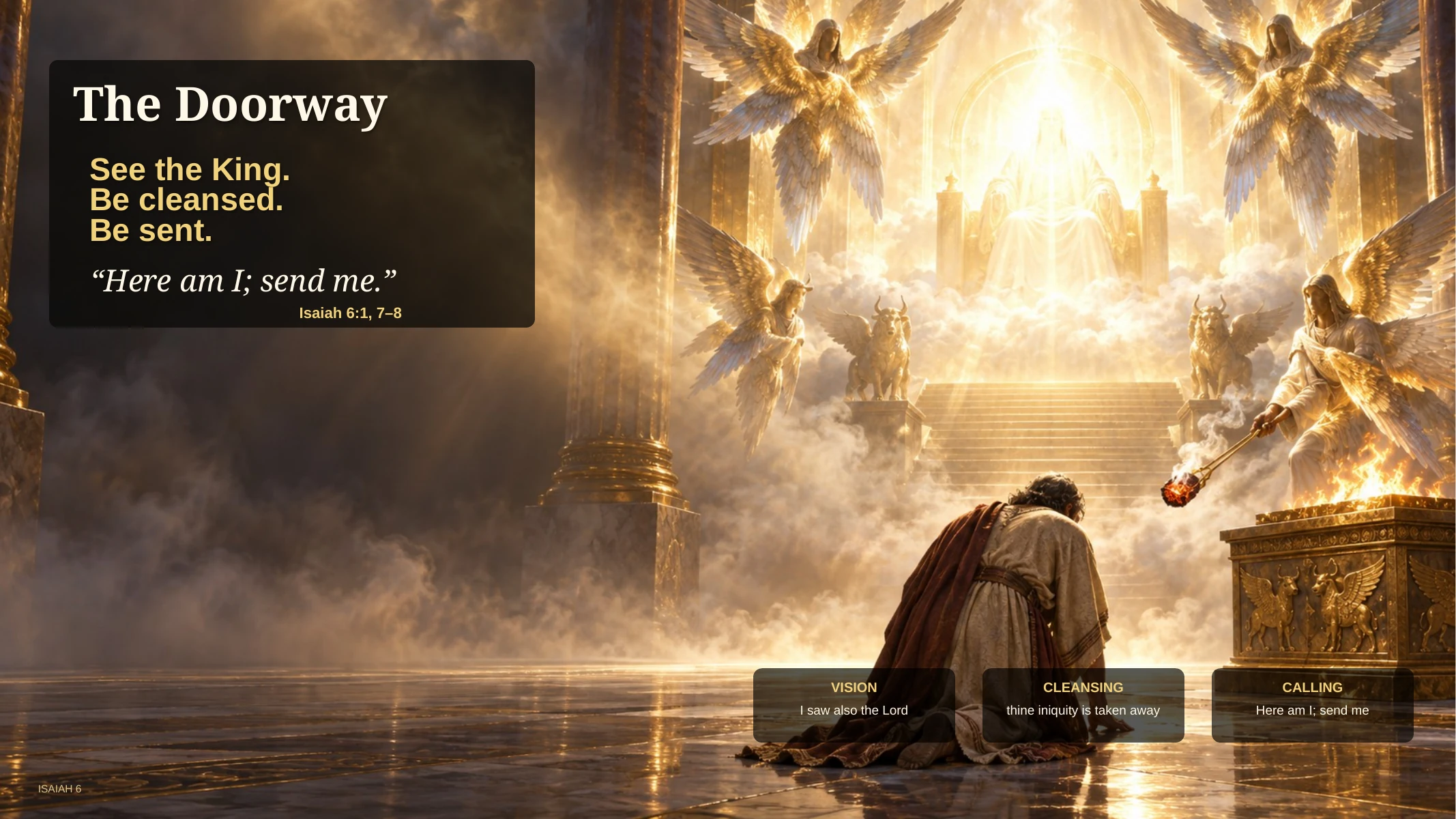
Chapter 6 opens in the year that king Uzziah died and describes Isaiah’s call. It invites us to read chapters 1 through 5 in light of that vision, even though those chapters sit before it on the page.
And what happens in chapter 6 is the pattern for everything else.
He sees the Lord. High and lifted up, the temple full of His train, seraphim standing above.
Then he breaks. Woe is me! for I am undone; because I am a man of unclean lips. He does not volunteer. He collapses.
Then he is cleansed — and look where the fire comes from. A seraph takes a live coal from off the altar with tongs, touches his mouth, and says thine iniquity is taken away, and thy sin purged. From the altar. Not from a furnace. From the place of sacrifice.
Then, and only then: Here am I; send me.
He does not volunteer clean. He volunteers cleansed — and that is the order every rung on the ladder follows.
(One note on the picture. The text gives the seraphim six wings apiece. Latter-day Saints generally understand angels as people, not winged beings, and read the wings as a symbol of power to move and act — see Doctrine and Covenants 77:4. That is a Latter-day Saint reading of an image the text plainly states.)
Nephi left chapter 1 out
Isaiah 2–12 appears as 2 Nephi 12–22 in the Book of Mormon. Isaiah 1 is absent there. Line them up.
2 Nephi 12 is Isaiah 2.
And here is a study hack worth writing in the margin of your scriptures. For thirteen chapters in a row, just add ten. Isaiah 2 is 2 Nephi 12. Isaiah 5 is 2 Nephi 15. Isaiah 11 is 2 Nephi 21. All the way to Isaiah 14, which is 2 Nephi 24.
Add ten. That is the whole conversion, and it holds for the entire block Nephi copied.
Which means you can read any chapter of this week’s assignment twice — once in the King James, once off the brass plates — and watch for where the wording differs. Nobody has to teach you that. You just need the offset.
A man cutting words into metal plates, with limited space and a lifetime of effort, copied eleven chapters and skipped the first one — the loudest chapter in the block. Scarlet and snow. The faithful city become a harlot. Silver become dross. Leaders of Sodom.
He did not choose casually. I worked through what that means in Did Nephi Mean What He Said About Isaiah?
Seven more codes

| The code | What it points to | See it this week |
|---|---|---|
| Jacob / Israel | the covenant people, usually under correction | Isaiah 9:8 |
| Zion / Jerusalem | the covenant destination — and a higher category of that same people | Isaiah 2:3 |
| Mountain / house of the Lord | the temple, and the nations flowing to it. Both at once | Isaiah 2:2 |
| Assyria | the invading world power | Isaiah 10:5 |
| The Holy One of Israel | Jehovah. Jesus Christ | Isaiah 1:4 |
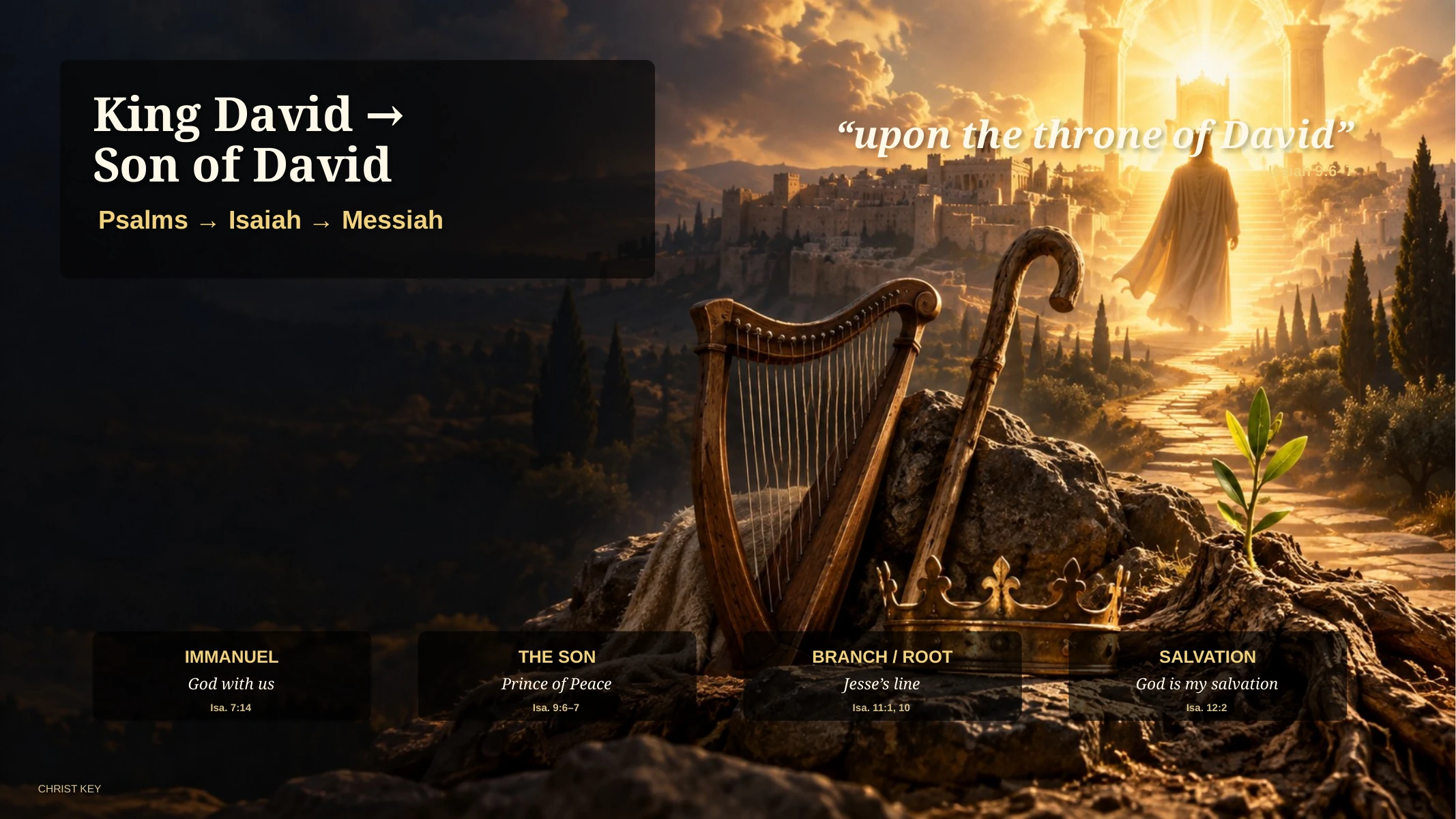
| Immanuel | God with us | Isaiah 7:14 |
| Branch / Root / Stem | the Davidic king, and the gathering | Isaiah 11:1 |
Start with Isaiah 9:8 — the Lord sent a word into Jacob, and it hath lighted upon Israel. Both names, one verse. That is the pattern, and once you have seen it once you will see it everywhere.
Two of these are worth another minute.
Assyria
Assyria is the empire that swallowed the northern tribes in Isaiah’s own lifetime. But in the end-time layer of the book, Assyria is the alliance of nations set against the covenant people. (Interpretation — and I label it that way.)
Assyria is the antagonist of the entire book. Every story needs one. Once you see who Isaiah’s is, half the book reorganizes itself in front of you.
Immanuel
God with us. Not near us. Not watching us. With.
The way He was with the sons of Mosiah, who walked into Lamanite country and preached there for fourteen years and came home alive.
The way He was with Helaman’s 2,060 young warriors — not one of them lost. All were wounded, and two hundred fainted from blood loss (Alma 57:25–26).
The way He was with David and his people. Second Samuel tells of victories over the Philistines, Moab, Edom, and Ammon, and it also tells us when David’s own choices brought grief. The record invites a closer reading than a tally of wins.
God with us is a covenant question to bring to those stories, not a battle count.
And here is something almost nobody points out, sitting in this week’s chapters.
Isaiah 11:14 says the Branch’s people will lay their hand on the Philistines, Edom, Moab, and the children of Ammon.
Those are not four names picked at random. Those are the four nations David subdued — Philistia, Moab, Edom, and Ammon, in 2 Samuel 8 and 10 through 12.
So in the chapter about a shoot growing out of the stump of Jesse — David’s own father — Isaiah lists David’s own conquests as the work of the King who is coming. (That is typology: the pattern is in the text, the reading of it is ours.)
The Son of David finishes what David started. It is right there in the week’s block, and you can check every one of those four against 2 Samuel yourself.
Now watch what that last one does.
A short detour on how we check things
I have repeated a tradition that David fought sixty-six battles without a loss. Scripture gives no such total, and I cannot show a reliable method that produces it. I should not teach it as a fact.
A better question is where was David? Second Samuel 11:1 says that, when kings went to battle, David remained at Jerusalem. That introduces the Bathsheba account. Later, his men urged him to stay away from another battle because his life mattered more to them than many of theirs (2 Samuel 18:3).
Those two absences mean different things. Read the verses and their context before drawing the lesson.
Human → AI → Human. I may use tools to find passages and challenge a claim, but their agreement is not evidence. I return to the scripture and other identifiable sources, then make the editorial judgment myself.
That is what searching looks like: asking, checking, and correcting a claim when its source does not hold. You can do it with a Bible and a pencil. Tools can make the search faster.
Isaiah 11 deserves its own stop

Go read Isaiah 11:1 and count the names.
“And there shall come forth a rod out of the stem of Jesse, and a Branch shall grow out of his roots.”
Rod. Stem. Branch. Then nine verses later a fourth one arrives, and it is not the same word as his roots in verse 1:
“And in that day there shall be a root of Jesse, which shall stand for an ensign of the people.”
— Isaiah 11:10
Four names. Stem, Rod, Branch, Root — all pointing at different things, and most of us have read past every one of them as poetry about a tree.
Now here is why that verse matters more than almost any other in this week’s block.
Joseph records Moroni quoting Isaiah 11
The night of September 21, 1823, a messenger appeared to a seventeen-year-old in an upstairs bedroom in upstate New York. Among what he quoted:
“He also quoted the eleventh chapter of Isaiah, saying that it was about to be fulfilled.”
— Joseph Smith—History 1:40
Then count the visits.
Three times that same night. Then a fourth the next morning, in the field, when Joseph collapsed climbing a fence. Then a fifth that same day at the hill, where he saw the plates and was forbidden to take them. And then he was told to return to that hill on the same day every year until the time came — which he did in 1824, 1825, 1826, and 1827.
Nine visits. And on the ninth — September 22, 1827, four years to the day after the first — Moroni handed him the plates. The record says the messenger repeated the same things each time.
Joseph was seventeen that first night. He was twenty-one before he was allowed to touch the plates, and twenty-four when the Book of Mormon went on sale in Palmyra on March 26, 1830.
Six and a half years from the first visit to the printed book. Most of it was waiting.
Here is a calendar connection worth examining. September 22, 1827 has been identified with Rosh Hashanah, the Feast of Trumpets, a day associated with repentance and the sounding of trumpets. That correspondence invites reflection; Joseph’s annual returns on September 22 do not mean each visit fell on the same Hebrew holy day.
Joseph named Isaiah 11. Cowdery named more.
In his own history Joseph records passages from Malachi 3–4, Isaiah 11, Acts 3, and Joel 2. Then he says this:
“He quoted many other passages of scripture, and offered many explanations which cannot be mentioned here.”
— Joseph Smith—History 1:41
Oliver Cowdery later gave a fuller account in the Messenger and Advocate. He was not present for Moroni’s visits, so his account is a later witness, not Joseph’s own transcript. The Church’s Pearl of Great Price student manual identifies Isaiah 28:21 and 29:11–14 among the passages Cowdery associated with Moroni’s message.
Look at the timing. Isaiah 11 is in this week’s block. Isaiah 28 and 29 are in next week’s. Joseph’s own history puts Isaiah 11 in the room, and Cowdery’s later account points to the chapters waiting just ahead. Read them and ask what gathering, a marvelous work, and the Lord’s strange act meant at the beginning of the Restoration.
Moroni’s first quoted passage in Joseph’s account was Malachi — and he changed the wording. Where our Bible reads he shall turn the heart of the fathers to the children, Moroni said it this way:
“And he shall plant in the hearts of the children the promises made to the fathers.”
— Joseph Smith—History 1:39
Jeremiah gives a striking scriptural parallel:
“I will put my law in their inward parts, and write it in their hearts.”
— Jeremiah 31:33
Plant it. Write it. In the heart. Joseph heard a message he would carry for years before the plates were entrusted to him.
Moroni knew something about engraving. He had spent the end of his own life cutting words into metal so they would outlast him and everyone he had ever loved. In Joseph’s telling, the messenger returned and repeated the message. The record had to be received before it could be brought into the world.
And then the Lord came back and explained it
Fifteen years later, in March 1838, the Lord answered direct questions about the eleventh chapter of Isaiah — and the answers are canonized as Doctrine and Covenants 113.
Who is the Stem of Jesse? Verily thus saith the Lord: It is Christ. (113:1–2)
What is the rod? A servant in the hands of Christ, who is partly a descendant of Jesse as well as of Ephraim, or of the house of Joseph, on whom there is laid much power. (113:3–4)
What is the root of Jesse? A descendant of Jesse, as well as of Joseph, unto whom rightly belongs the priesthood, and the keys of the kingdom, for an ensign, and for the gathering of my people in the last days. (113:5–6)
Three answered. Stem, Rod, Root.
Now count again. There were four.
The Branch is not defined. The Lord answers the other three by name, plainly, and says nothing whatever about the Branch. Go read section 113 and see for yourself — the question is never asked and the answer is never given.
And here is what makes that gap hard to walk past. Of the servant, Isaiah says this:
“In the shadow of his hand hath he hid me… in his quiver hath he hid me.”
— Isaiah 49:2
Hidden. Twice, in one verse.
So: three of the four named out loud in modern revelation — and one left in the dark, in a chapter Joseph records Moroni quoting. (That the silence is deliberate is interpretation. That the silence is there is a fact you can check in four minutes.)
Joseph recorded the angel quoting the chapter. A later revelation explains three of its four named figures.
Which is exactly the pattern the Savior used in 3 Nephi 23 — read Isaiah aloud, then command us to search it. Neither of them handed over the answer. Both of them assigned the work.
That is the strongest argument I know that this book is meant to be searched rather than skimmed. Joseph records the angel quoting one of its chapters, and a later revelation returns to its symbols.
What the man who wrote it paid
Isaiah’s ministry ran roughly forty years — the manual dates it between 740 and 701 BC — across the reigns of four kings.
By ancient tradition he did not die quietly. Hebrews 11:37 says of the prophets that they were sawn asunder, naming no one; Jewish and early Christian writers alike connect that line to Isaiah, killed under King Manasseh, hidden inside the hollow of a tree, and sawn in two with a wooden saw. (Tradition, not scripture.)
Forty years encoding a book so it would survive, and it cost him that.
The book came through. The Great Isaiah Scroll from Qumran preserves all sixty-six chapters in their familiar order. It is roughly a thousand years older than the medieval Hebrew manuscripts available before the discovery, though its text also has many variants. See the Israel Museum’s comparison. I wrote that one up in A Shepherd Threw a Rock Into a Cave.
This week

Two things, and neither takes long.
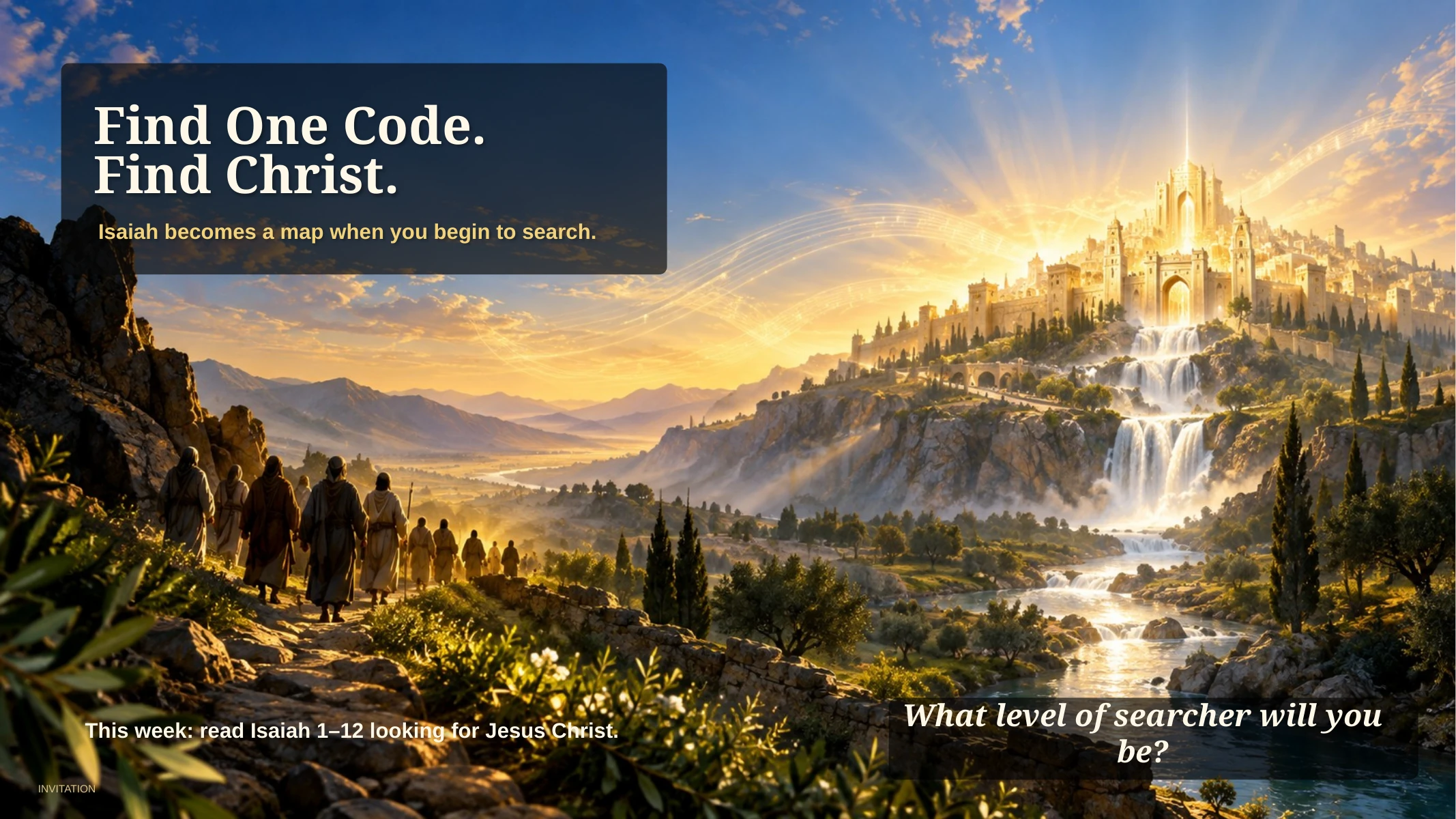
Find yourself on the ladder. Not to feel bad about it — skip is level one, not a failure. Just know which rung you are on, and take one step forward.
Then read looking for one code. Jacob and Israel in the same verse. Zion and Jerusalem in the same verse. The mountain of the Lord’s house. Immanuel. The Branch. Mark them when you see them.
And the question underneath all of it, which the manual asks too: where is Christ in this chapter?
In the next lesson
The September 21–27 reading is Isaiah 13–14; 22; 24–30; and 35. Chapters 28 and 29 are especially worth watching: Isaiah 28 names the Lord’s strange work, and Isaiah 29 speaks of a marvelous work and a wonder.
Here is a connection I cannot stop thinking about. After the Philistines came against David in the Valley of Rephaim, he named the place Baal-perazim (2 Samuel 5:20).
David said, the Lord hath broken forth upon mine enemies before me, as the breach of waters (2 Samuel 5:20). The place name carries that image of breaking through.
Centuries later, Isaiah reaches back to that place:
“For the Lord shall rise up as in mount Perazim…”
— Isaiah 28:21
Isaiah 28 is in next week’s block. Oliver Cowdery’s later account connects Isaiah 28:21 with Moroni’s message.
And read what Isaiah does with it. The God who broke through for David at Perazim is, in Isaiah 28, rising up to break through against His own covenant people — the rulers who had made a covenant with death. Isaiah calls it His strange work.
Same God. Same verb. Other direction.
Read Isaiah 28 and ask why he calls this the Lord’s strange work.
Download the complete lesson slides (PDF, 9 slides).
Part of a weekly Come Follow Me series walking through Isaiah. Ken Krogue is the founder of The Covenant Project and has been deeply studying Isaiah for more than ten years.
Human → AI → Human: Conceived and directed by Ken Krogue → researched, challenged, and developed with Orson (Claude) and Nathan (ChatGPT) → with Ken Krogue holding final editorial judgment. Visual concepts and production were developed with AI under human editorial direction.
Related Posts


Don't Miss a Post!
Stay up to date with the latest news, fulfilled prophecies, and study tips